Your first week of barber school is mostly theory, not haircuts. At most schools, including American Barber Institute, the first couple of weeks cover the foundations: sanitation and sterilization, how to handle your tools safely, the history of barbering, New York barber law and the basics of running a shop. You'll get to know your tool kit, your instructors and your classmates, and you'll be working on real clients in the student clinic within the first few weeks. Here's what that first stretch looks like and how to make the most of it.
Why does barber school start with theory?
Many new students show up ready to pick up the clippers on day one, and it's natural to feel a little impatient. But there's a good reason the program starts in the classroom. Barbers work with sharp tools, close to the skin, on the public, every single day. Before you touch a client, you need to know how to keep them safe.
At ABI, the first two weeks or so are theory, covering:
- Sanitation and sterilization: how to clean and disinfect tools and your station, how to prevent the spread of infection, and how to handle anything that comes in contact with skin or blood.
- Barber history: where the trade comes from and how it has evolved.
- New York barber law: the rules that govern licensing and practice in the state, which you'll be expected to follow for your whole career.
- Shop management: the business side of barbering, which matters if you ever rent a chair or open your own shop.
This foundation isn't busywork. Sanitation habits you build now are the ones you'll carry into every shop you work in, for your entire career.
Sanitation: the habit that defines a professional
If there's one thing to take seriously from the first week, it's sanitation. Clients notice when a barber cleans the clippers, uses a fresh neck strip and keeps the station tidy. They also notice when a barber doesn't. Treat every sanitation step as a routine you do automatically, not a checklist you rush through. The sooner it becomes muscle memory, the easier everything else gets. If you want to see where all this training is heading, the NY Department of State publishes the list of tasks evaluated on the barber practical exam you'll take after graduation.
Your tool kit
Tools, books and supplies aren't included in tuition. You'll receive a tool list at registration, and you can buy your kit from ABI or anywhere else. A typical barber kit includes clippers, trimmers, shears, a straight razor, combs and brushes, along with capes and other supplies.
During the first week, get comfortable with each tool before you ever use it on a person. Learn how it feels in your hand, how to clean it, how to store it, and how to change guards or blades. Label your tools if you can. In a busy classroom, everyone's black clippers start to look the same.
What to bring and wear
Your school will tell you its specific dress code and supply requirements, so follow those first. In general, it helps to:
- Bring your tool kit, books and a notebook every day, starting from the day your school asks for them.
- Wear comfortable, clean, professional clothes. You'll be on your feet for long stretches.
- Choose comfortable, closed-toe shoes. Hair gets everywhere, and you'll be standing a lot.
- Pack water and a snack, especially if you're coming straight from work to an afternoon class.
- Bring a positive attitude and questions. Your instructors expect them.
When do you start cutting real clients?
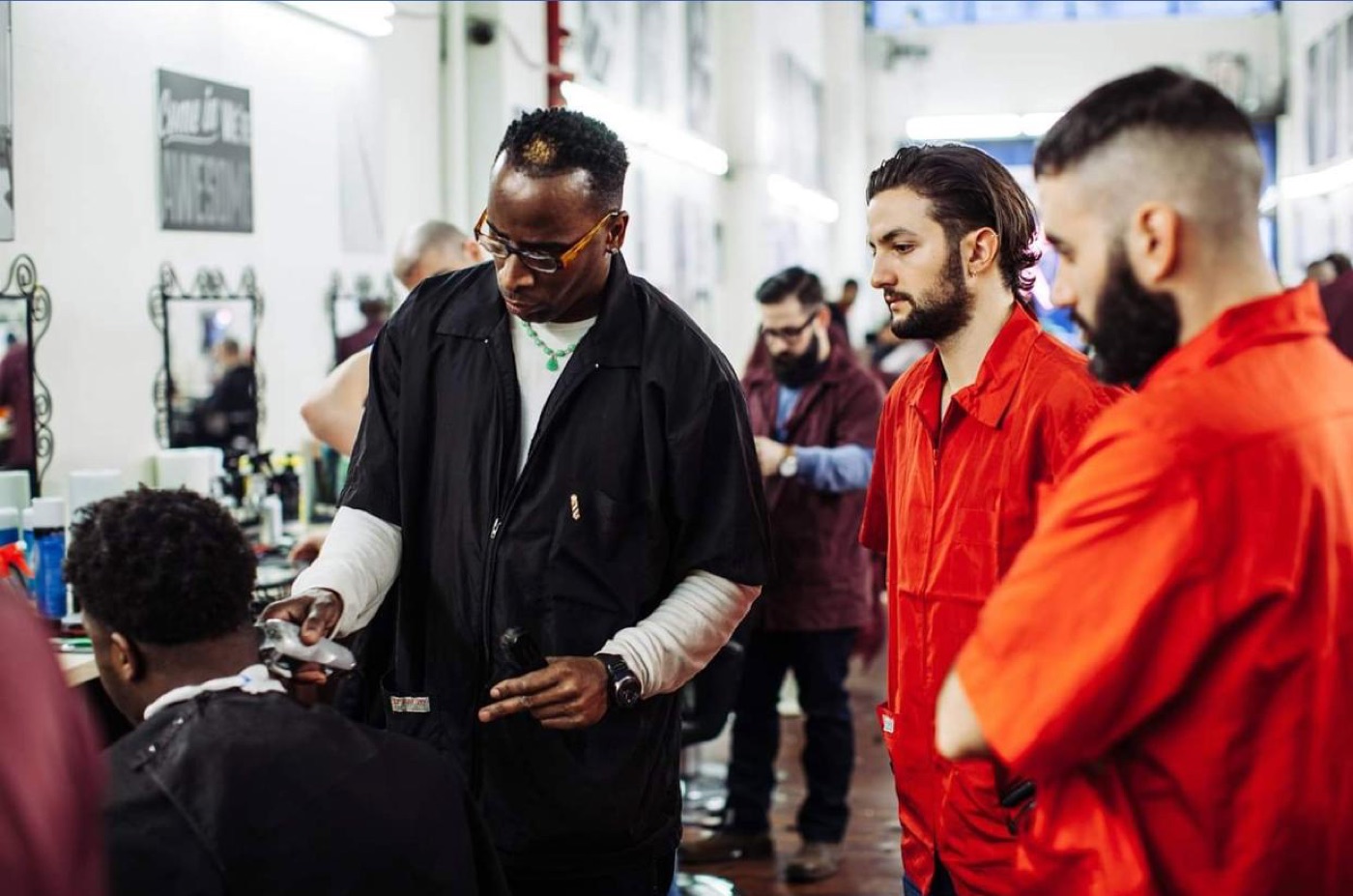
Once the theory block is done, you move into hands-on training. At ABI, students begin working on real members of the public in the supervised student clinic within the first few weeks. Licensed instructors watch, guide and step in when needed, so you're never on your own.
From there, the curriculum builds up through classic tapers, low, mid and high fades, caesars, shape-ups and razor lineups, beard trims, scissor and clipper cuts, and more advanced work like hot-towel shaves. For a closer look at the cuts you'll learn, read our guide to the types of fades every barber student learns, or see the full skills and techniques list.
Tips to get the most out of your first week
- Show up on time, every day. Barber school is measured in hours, and you need all 500 of them to finish, so treat attendance like a job.
- Take the theory seriously. It's the foundation for every haircut you'll ever give.
- Take notes. Write down the sanitation steps and the terms your instructors use. You'll refer back to them.
- Watch the advanced students. Seeing someone a few months ahead of you on the clinic floor shows you where you're heading.
- Ask questions early. It's much easier to fix a habit in week one than in month three.
- Get to know your classmates. They'll be your practice partners now and part of your professional network later.
- Be patient with yourself. Nobody gives a great fade in their first week. Everyone starts in the same place.
Before day one: getting enrolled
To enroll at ABI you need to be at least 17 (under 18 needs parental permission), and you'll need a high school diploma or GED, or you can pass the Ability-To-Benefit entrance exam at the school. You'll also bring a Social Security card or Tax ID, proof of address and a photo ID. New classes start the first Monday of every month (the Tuesday when a federal holiday falls on that Monday), on morning, afternoon and weekend schedules, at both the Manhattan and Bronx campuses. Our how to get started page walks through each step.
Have questions before your first day? Call (212) 290-2289 (English) or (212) 290-0278 (Español) for Manhattan, or (718) 676-0640 for the Bronx. The office is open Monday to Friday, 8 AM to 8 PM, and walk-ins are welcome.
Frequently Asked Questions
What do you do in the first week of barber school?
The first week is mostly theory: sanitation and sterilization, safe tool handling, barber history, New York barber law and shop management. At American Barber Institute, this theory block lasts about the first two weeks.
When do barber students start cutting real clients?
At ABI, students start working on real members of the public in the supervised student clinic within the first few weeks, once the theory block is done. Licensed instructors watch, guide and step in when needed.
Are tools included in barber school tuition?
Not at ABI. Tools, books and supplies are extra; you get the tool list at registration and can buy your kit from ABI or anywhere else.
What should I wear to barber school?
Follow your school's dress code first. In general, wear clean, comfortable, professional clothes and closed-toe shoes, because you'll be on your feet for long stretches and hair gets everywhere.
What do I need to enroll in barber school in NYC?
At ABI you need to be at least 17 (under 18 needs parental permission) and have a high school diploma or GED, or pass the Ability-To-Benefit exam at the school. You also bring a Social Security card or Tax ID, proof of address and a photo ID.
Ready to start your barbering career? Explore the 500-Hour Master Barber Program or book a free tour.